

Provides a concise but comprehensive description of how impacts in the economy are derived from government support of technology development companies.
HAL has developed a reputation for thorough economic and social analysis. The focus of many federal S&T programs, and the rationale for continued federal support, has shifted towards clearly serving the needs of stakeholders and demonstrating benefits. We have used our technology assessment methodology in support of federal and provincial departments and agencies interested in determining these benefits. The methodology has been shown to be a useful tool in providing structure and consistency to our quantitative and qualitative assessments.
FRAMEWORK OVERVIEW
A concise but comprehensive description of how impacts in the economy are derived from technological activity is essential to provide a common understanding of the roles of the different participants. The HAL Technology Assessment Framework shown below provides the description. It has been used to:
- Explain the factors and considerations influencing the translation of technology into economic impacts;
- Guide preparation of the questions for studies to insure that key information is collected; and
- Present results from studies in a common format for analysis.
The HAL Technology Assessment Framework has five main parts. Central to the framework is the Study Company that undertakes contracted activities, technology development activities, and product development, production and marketing activities. The Study Company is influenced and assisted by the government through the procurement of goods and services, the activities of government laboratories, and government programs. The study company, in turn, influences the rest of Canadian industry by forming formal and informal alliances with other companies, and by unintentional diffusion of skills and knowledge to other companies. The Study Company also affects the Canadian users of its goods and services by providing quality and productivity improvements in their activities. In the end, the activities of the study companies, Canadian government, Canadian industry, and Canadian Users result in impacts on the Canadian economy in the form of infrastructure improvements, wealth creation, and the public good.
The HAL Technology Assessment Framework
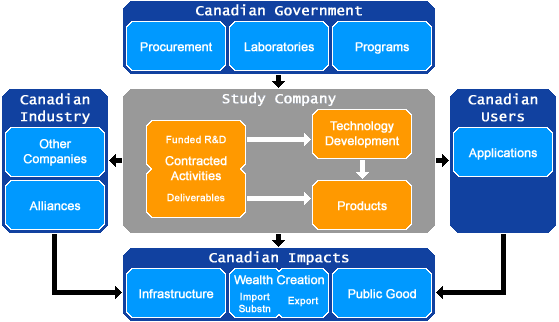
Economic returns from technology come from the commercialization and application of the technology rather than from its development. When assessing the potential payoff from technology development, it is these downstream benefits that must be identified and estimated.
Traditionally, impacts have been thought of in terms of direct wealth creation – stimulating the economy through the production and sale of tangible goods in the economy, usually by the private sector. In addition, we know that technology can enhance the social well-being of a country (the public good), and the infrastructure. Research into infrastructure improvement, such as faster communications systems or improved methods and codes, ultimately contribute to productivity, wealth creation and the public good.
Wealth Creation
Wealth Creation comes from the production and sale of goods and services. Impacts include:
- Employment effects;
- Trade of goods and services;
- Productivity effects; and
- Exports and import substitution.
Infrastructure
In its broad context, infrastructure comprises:
- Physical structures including buildings, facilities, machines, equipment, experimental apparatus, instruments, communications, libraries, databases, computers, software and the operating systems and procedures specific to each structure;
- Institutional structures and systems including management systems, regulations, standards, codes, laws, dispute resolution mechanisms, etc.;
- Knowledge, information and technology;
- Human resources with experience and expertise; and
- Social and cultural values, codes, habits, rituals, heritage, expectations, etc.
Investment in infrastructure can be manifested in several ways:
- Direct investment to expand facilities or operations in Canada;
- Direct investment to start up a new operation or subsidiary in Canada;
- Investment in R&D, technology transfer or product development with commitments or guarantees as to the application of the results to benefit Canada; and
- Investment in the development of linkages or alliances among industrial partners, or between industrial and government (laboratory) partners, to yield new products and services for the future.
Infrastructure has the following attributes:
- Infrastructure is an asset that is created or built up over time.
- Infrastructure must be maintained regularly but also depreciates (or becomes obsolete) and must be upgraded or replaced over time.
- Infrastructure requires significant resources (and time) to be changed or modified since it is an asset (i.e. has significant built-up value).
- Infrastructure must be utilized to be productive – it does nothing by itself.
Much infrastructure is location-specific and needs to be interconnected or linked to produce benefits. Location of infrastructure is an important instrument of regional development policy.
Public Good
Public good impacts can include:
- Quality of life;
- Public safety;
- Public health;
- National security;
- Environment; and
- National pride.
CONSIDERATIONS
When analyzing the results of a program, the following considerations should be kept in mind.
Incrementality
The impacts and effects to be considered are those which are directly due to the government action under review. These impacts and effects are called incremental, which is defined as the difference between what did happen with the government action (such as procurement), and what would have happened if the action had not been taken. If nothing changes as a result of the action, impacts and effects are the same with and without the action, and incrementality would be zero.
Attribution
A concept related to incrementality is that of attribution. Even if the government action makes incremental differences in impacts, some fraction of the impacts may logically be attributable to other programs, funding sources, organizations or stimulants. Impacts and effects may have benefited from more than one government program or policy. Such incremental activities may give rise to impacts and effects that are not wholly (or fairly) attributable to the government action under consideration. In these cases, if the other programs or activities are to be credited with some of the impacts, these impacts must be attributed to the various contributing programs in some way. To the extent these other sources can be identified, they should share in the allocation of impacts and effects associated with the government action.
Time
Time frame plays an important role in the assessment of impacts. The major benefits attributable to R&D and technology transfer will accrue to society long after completion of particular government activities and over many years into the future.
This causes difficulties for identifying and measuring impacts and attributing them to the originating activity. These difficulties involve:
- The uncertainty as to whether the program-assisted development will actually be implemented commercially to take advantage of the potential benefits;
- The uncertainty as to whether the technology will perform after implementation as expected based on results from prototype or demonstration experience;
- The lack of knowledge on the unintended or unexpected effects of introducing new technologies or changing existing processes; and
- The uncertainty of the level of benefits and costs from any particular implementation of technology.